Guide to Writing an Expository Essay: How-To with Examples

Master expository essays with clear definitions, five essay types, a full outline walkthrough, writing tips, topic ideas, and real examples you can model right now.
📋 Table of Contents (12 sections) ▼
- Introduction
- What is an Expository Essay?
- Types of Expository Essays
- Structure of an Expository Essay
- Tips for Writing a Good Introduction
- Writing Tips
- Expository Essay Topics
- Examples of Expository Essays
- Common Mistakes to Avoid
- Why Are Expository Essays So Important?
- Expository Essays FAQ
- Conclusion
Introduction
"Just the facts, ma'am." Remember that line? It's a catchphrase attributed to Joe Friday from the old show Dragnet. But it perfectly sums up what it means to write an expository essay.
Teachers often assign expository essays to assess a student's learning on a subject. The term "expository" means to expose, expound, or explain. When you write an expository essay, you are exposing the main ideas of a subject, elaborating on it, or explaining the meaning of it in some detail. In 2026, with information more abundant and easier to access than ever before, the ability to filter, organize, and clearly explain what you know has become one of the most valuable academic and professional skills you can develop.
So, what's an expository essay?
An expository essay is a structured essay that informs the reader about something, explains something, or describes something—and it does so with perfect clarity and precision.
In this article, we'll look at the definition, types, structure, writing tips, and common mistakes associated with writing an expository essay. We'll also give some practical examples and answer those frequently asked questions students tend to have when tasked with this kind of writing.
Let's begin.
What is an Expository Essay?
An expository essay is a genre of writing that explores and explains a specific topic in a logical and straightforward manner.
The main goals of expository writing are to inform the reader, explain a subject, or describe a topic in a way that is accessible and comprehensible. You're not trying to confuse or overwhelm a reader with all of your vast knowledge. You're trying to illuminate and help the reader. Think of it as translating complexity into clarity—taking something dense, technical, or multi-layered and presenting it in a way that any thoughtful reader can follow and understand.
An expository essay is different from a persuasive or argumentative essay. The latter may draw on emotional appeals to make a point. Expository writing relies solely on facts and nothing but. That distinction matters more than ever in an era when opinion masquerades as fact across social media feeds and online comment sections. A well-crafted expository essay stands apart precisely because it refuses to editorialize.
Although an expository essay might involve some research or reference to outside sources, it is also different from a research paper. The goal is to bring a subject into relief in a simple but effective way. A research paper digs deep into primary sources and original data; an expository essay synthesizes what is already known and presents it accessibly.
When you write an expository essay, pretend you are a teacher. Your goal is to inform the reader by providing facts about a subject or explaining its importance or meaning. An expository essay can be about literature, the arts, history, business, or religion—almost anything, really. What ties all of these subjects together is the same fundamental commitment: give your reader accurate, well-organized information and let the facts do the work.
Types of Expository Essays
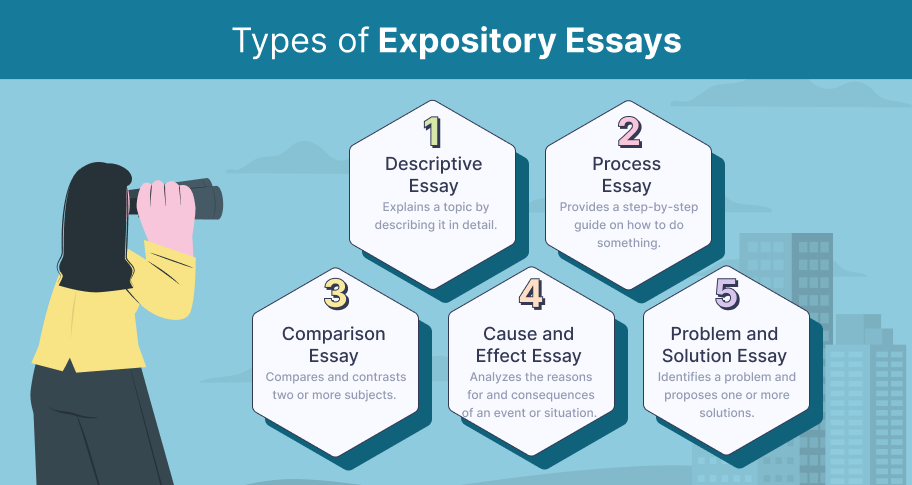
| Type of Expository Essay | Description | Example 1 | Example 2 |
|---|---|---|---|
| Classification Essays | Organizes and categorizes subjects into different groups. | An essay that explains the classifications of art movements over the centuries. | An essay categorizing types of social media platforms. |
| Definition Essays | Clarifies the meaning of a term or concept. | An essay that defines the concept of gender through the lens of feminism. | An essay defining the term artificial intelligence. |
| Process Essays | Explains the steps involved in a process. | An essay that explains the supply chain process in manufacturing a Tesla. | An essay describing the process of making homemade bread. |
| Compare-and-Contrast Essays | Highlights similarities and differences between two subjects. | An essay that tells what was same but different about the book and its film adaptation. | An essay comparing online learning to traditional classroom learning. |
| Cause-and-Effect Essays | Examines the causes of a phenomenon and its effects. | An essay that explains what causes burnout among nurses and what effect it has on nursing staff. | An essay showing the causes and effects of nationalism throughout history. |
It is worth noting that these five types are not always mutually exclusive. A well-developed expository essay on, say, climate policy might blend elements of cause-and-effect analysis with classification of different policy responses. Recognizing which type—or which combination of types—best fits your topic is itself a mark of strong expository thinking. When in doubt, ask yourself: am I primarily defining, categorizing, sequencing, comparing, or tracing cause and effect? Your answer should guide which structural framework you reach for first.
Structure of an Expository Essay
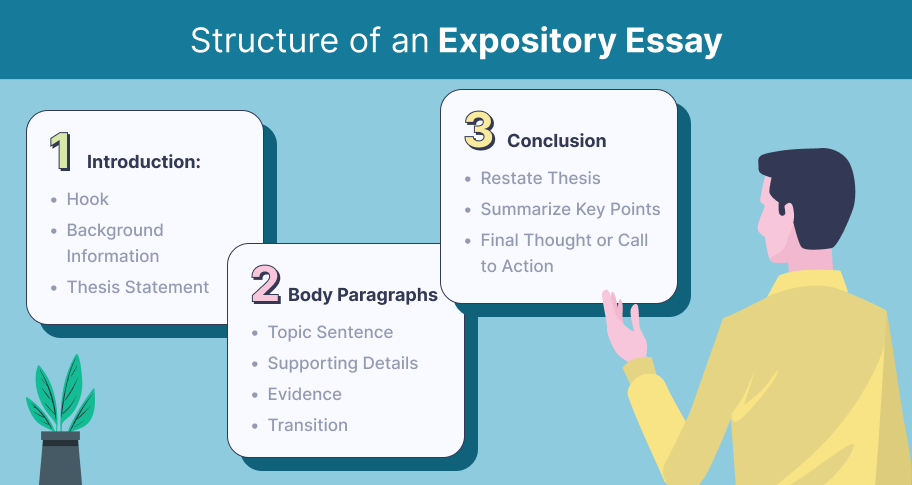
The structure for an expository essay should be similar to other academic essays, with an introduction, body paragraphs, and conclusion. This three-part architecture is not arbitrary—it mirrors the natural arc of good explanation: orient the reader, deliver the substance, and then consolidate understanding. Each section carries its own weight and its own obligations, and neglecting any one of them weakens the whole essay.
Outline
Outline Template:
- Introduction: Opening statement, main points, thesis.
- Body Paragraph 1: Topic Sentence, Evidence, Analysis
- Body Paragraph 2: Topic Sentence, Evidence, Analysis
- Body Paragraph 3: Topic Sentence, Evidence, Analysis
- Conclusion: Summarize main points.
Keep in mind that longer or more complex essays may require additional body paragraphs—four or five is entirely appropriate for a topic with multiple distinct facets. The three-paragraph body shown above is a minimum framework, not a ceiling. Adjust the number of body paragraphs to match the scope of your topic and the length requirements set by your instructor.
Introduction
Opening statement: Diverse workplaces are 35% more likely to outperform their more homogenous counterparts.
Main points:
1. Workforces are more diversified than ever before due to globalization, but also due to changing social norms.
2. A diverse workforce also has the potential to offer creative and innovative solutions that can help companies gain competitive advantage.
3. Diversification is part of corporate social responsibility, which improves the company's reputation and brand identity.
Thesis: Companies with strong diversity management policies will be equipped to meet the challenges of a globalized workforce.
First Body Paragraph
Topic Sentence: Workforces are more diversified than ever before due to globalization, but also due to changing social norms.
Evidence: Globalization has encouraged companies to establish a presence in multiple countries, creating an international workforce. Even domestic companies are diversifying due to changing demographics in the labor force.
Analysis: Companies are recognizing that a diverse workforce reflects the values and norms of the current generation.
Second Body Paragraph
Topic Sentence: A diverse workforce also has the potential to offer creative and innovative solutions that can help companies gain competitive advantage.
Evidence: When a company expands into a new market, it needs to understand the new target market's values, norms, and beliefs. Likewise, a company entering a new market needs strategic methods of communicating products and services.
Analysis: Companies with diverse workforces will have a competitive advantage over companies that do not. A diverse team will be capable of coming up with more novel ideas than a homogenous team because each member will think differently about each issue or challenge.
Third Body Paragraph
Topic Sentence: Diversification is part of corporate social responsibility, which improves the company's reputation and brand identity.
Evidence: Corporate social responsibility is a top-down process whereby senior management commits to an ethical approach to human resources practices.
Analysis: Corporate social responsibility boosts a company's image among consumers and can be incorporated into public relations and media relations strategies. In 2026, with consumers and job candidates alike paying closer attention to organizational values, companies that embed diversity into their CSR frameworks consistently earn stronger brand loyalty and attract higher-quality talent.
Conclusion
Summation: To sum up, a diverse workforce presents a strategic advantage for companies, allowing for more innovative marketing and improved public relations. Diversity is part of corporate social responsibility, which is becoming increasingly important for remaining competitive. Diverse teams bring more to the table, enabling the most creative solutions. Overall, diverse workforces facilitate breaking into new markets.
Tips for Writing a Good Introduction
There are a few pre-writing steps you can take to help prepare your introduction. The initial step is to brainstorm. After you have decided on the topic you will tackle in the expository essay, you will want to brainstorm your ideas. Methods of brainstorming include a free writing session, in which you quickly jot down some thoughts without censoring yourself. Another type of brainstorming method involves drawing pictures or diagrams such as word maps. You can also brainstorm with other people like your classmates or a writing tutor.
Next, take what you have learned in your brainstorming session and start doing some research to substantiate your main ideas. Now that you have a strong idea about what you want to write about, you can develop an outline. The outline of your expository essay gives you a road map. Use that roadmap to help steer your introduction.
First, start with a hook—some question or statement that can literally pull the reader from across the room. It should be a line that really gets a person's attention. A striking statistic, a counterintuitive fact, or a sharply posed question all make strong hooks. What you want to avoid is a vague, meandering opener that makes the reader work too hard to figure out what the essay is about.
Second, follow that hook up with the main points that will be discussed in more detail in the body paragraphs. Think of these as signposts: you are letting the reader know exactly where the journey is headed before it begins. This kind of transparency is a hallmark of effective expository writing.
Third, conclude the introduction with your thesis statement, i.e., what you are going to show in your paper. The thesis is the single most important sentence in your entire essay. It tells the reader the central idea and, ideally, the scope of what follows. A strong thesis is specific, focused, and arguable in the sense that it takes a clear position on what the essay will explain or establish.
Writing Tips
Thesis Statement: How to craft a compelling thesis.
Make sure your thesis is specific, clear, and that it outlines the main points of your essay. A common mistake is writing a thesis that is too broad—something like "Social media has changed communication" tells the reader almost nothing. A stronger version narrows the claim: "The proliferation of short-form video platforms has fundamentally altered how younger generations consume and evaluate news, prioritizing visual brevity over in-depth analysis." That kind of thesis gives both you and your reader a precise road map for the paragraphs ahead.
Objective Tone: Importance of maintaining a neutral, fact-based tone.
Maintain an objective tone by avoiding personal opinions and focusing on factual information. There should be NO editorializing in an expository essay. NO authorial intrusion. NO personal points of view or feelings on the matter. NO bias. ONLY facts! Remember Dragnet!
One practical test: after drafting a paragraph, go back and underline every sentence that begins with "I think," "I believe," "In my opinion," or similar constructions. If you find any, rewrite them. Replace "I think social media is harmful" with "Research published in peer-reviewed journals has linked heavy social media use to increased rates of anxiety among adolescents." The shift from opinion to evidenced claim is the shift from weak writing to strong expository writing.
Fact-Checking: Use accurate information and credible sources.
But, of course, your facts must be correct. Verify the accuracy of your information and use credible sources to support your arguments. Don't go basing your expository essay on info you grabbed from some random blogger with an axe to grind, a bone to pick, an agenda to hammer home, or some audience to target. Facts need to be backed up by reason, logic, data, argumentation.
In 2026, the landscape of credible sourcing has expanded considerably. Peer-reviewed journals accessible through databases like JSTOR, PubMed, and Google Scholar remain gold standards. Government and institutional reports—from bodies like the World Health Organization, the U.S. Bureau of Labor Statistics, or the Pew Research Center—are also reliable. Reputable news organizations with established editorial standards are acceptable for current events. What to avoid: anonymous websites, self-published opinion blogs, undated web pages, and any source that cannot be traced to a named expert or organization with accountable editorial oversight. When in doubt, cross-reference: if two or three independent credible sources confirm the same fact, you can use it with confidence.
Strategies for a Strong Conclusion
There are three things you'll want to do for a strong conclusion. The first is to restate your thesis in a new way. Don't just copy/paste it from the intro. Polish it off and give it some new light to make it pop. The second thing to do is to summarize your main points. Again, make them new—but the main ideas should be the same. Third, leave the reader with a final thought. This can be a call to action or something that they can ponder after reading your essay.
A strong closing sentence is one that resonates—something that gives the reader a sense of completion while also gesturing toward the broader significance of the topic. Think of it as the moment when the camera pulls back from the close-up: you have shown the reader the details, and now you give them a brief, satisfying glimpse of the larger picture. Avoid introducing new arguments or evidence in the conclusion; everything substantive belongs in the body. The conclusion is your final opportunity to cement the clarity that good expository writing demands.
Expository Essay Topics
Expository essays can be about almost anything. Having trouble coming up with an expository essay topic? Here are some ideas.
Religion
- Explain the Four Noble Truths of Buddhism.
- Discuss the theme of submission in Islam.
- What are three general doctrinal differences between Protestantism and Catholicism?
- Compare and contrast two different Native American religions.
- Describe the role of ritual and ceremony in indigenous African spiritual traditions.
History
- Discuss the causes and effects of the Protestant Reformation in Europe.
- What were the causes of the Civil War?
- Describe the spread of Buddhism from India to East Asia.
- Explain Jared Diamond's theory in Guns Germs and Steel.
- Explain the rise of global terrorism, and jihadism in particular.
- Describe the historical and political factors that led to the decolonization movements of the mid-twentieth century.
Business
- What does it mean to be a learning organization and why is it important?
- Describe two different risk management strategies, and explain which one would be more appropriate for your selected company.
- Differentiate between different models of leadership, using examples from case studies.
- Write an expository essay on the impact of labor laws on the ways businesses operate.
- Explain how supply chain disruptions in the 2020s reshaped corporate inventory and logistics strategies.
Nursing
- What are three of the most important philosophies of nursing and why?
- Explain the importance of evidence-based practice.
- What are the most important characteristics or roles of a nurse leader?
- Why is it important for a nurse to be a patient advocate?
- Describe the impact of staffing shortages on patient outcomes in hospital settings.

Literature
- Explain the themes of Flannery O'Connor's short story "A Good Man is Hard to Find".
- Compare and contrast Hamlet and Oedipus as tragic heroes.
- Analyze the character of Rama in the Ramayana.
- Discuss the literary devices Walt Whitman uses in Leaves of Grass.
- Explain how the unreliable narrator functions in twentieth-century American fiction, using two or three specific novels as examples.
Political Science
- Explain the instruments of power used in foreign policy and strategy.
- Compare and contrast Machiavelli's The Prince with Sun Tzu's Art of War.
- What are the similarities and differences between liberalism, neo-liberalism, and realism?
- What strategies would you recommend for resolving the crisis in the Middle East?
- Describe the role of international institutions such as the United Nations in mediating geopolitical conflicts in the 2020s.
Art
- Choosing two artists, show how each uses chiaroscuro in their paintings.
- Offer a formal analysis of any one of DeKooning's paintings.
- Explain some of the defining features of Impressionism.
- How and why did cubism and abstraction evolve? In your discussion, explain the social, cultural, historical, and political context of these movements.
- Explain how digital art and AI-generated imagery are challenging traditional definitions of authorship and artistic value.
Technology and Society
- Explain how large language models work and what limitations they currently face.
- Describe the concept of digital privacy and explain the key regulations that govern it in the United States and Europe.
- What are the main differences between machine learning and traditional software programming?
- Explain the causes and consequences of the global semiconductor shortage that began in the early 2020s.
Examples of Expository Essays
Sample Essay 1: Cloud Computing
Ever wondered what cloud computing was and what it had to do with the weather? The answer is—nothing! Cloud computing refers to the delivery of on-demand computing services, such as servers, storage, databases, networking, software, analytics, intelligence, and more, all over the Internet. It is a remote service that allows businesses to store and handle information without physically managing their own hardware and software. Cloud computing offers several advantages, such as scalability (adding or removing resources as needed), cost-effectiveness (pay-as-you-go model), and increased accessibility (data accessible from anywhere with an Internet connection). As of 2026, cloud computing has become foundational infrastructure for enterprises of virtually every size, with major providers like Amazon Web Services, Microsoft Azure, and Google Cloud Platform collectively serving hundreds of millions of users worldwide. However, companies still need to think about security and data privacy, so they will want a cloud provider with a reputation for risk management. This paper explains the services rendered by cloud computing and the challenges that remain.
Analysis: This example effectively explains cloud computing by:
- Defining the concept: Provides a clear definition of cloud computing and its key services.
- Benefits: Outlines the advantages of cloud computing for businesses and individuals.
- Security Concerns: Acknowledges potential security risks.
- Focus on Accessibility and Scalability: Highlights the flexibility and ease of use offered by cloud computing.
- Current context: Grounds the topic in the present landscape of major providers and widespread adoption.
- Thesis: It concludes with a statement of what the paper will show.
Sample Essay 2: Street Art
Street art, or urban art as it is also known, refers to visual art created in public spaces, usually on walls, buildings, or even signposts, streets and sidewalks. It is a broad category of art that includes various styles and techniques, such as large and small murals, stencils, graffiti, and wheatpasting. Street art is unique in its overall aim in that it acts as a direct challenge to traditional notions of art insofar as it reclaims public spaces and engages viewers directly (without their having to go to a museum or designated venue). Because it is a proactive kind of art in that sense, street art can be used for social commentary, political movements, beautification of urban landscapes, or just plain old simple artistic expression. Street art's legality is often debated, however, with some viewing it as vandalism and others as a legitimate art. One thing that is for certain is that street art has the power to be provocative and bring vibrancy to urban environments in need of livening up.
Analysis: This example effectively explains street art by:
- Definition and Scope: Provides a concise definition that encompasses different styles and techniques.
- Purpose: Highlights the various goals of street art, from social commentary to artistic expression.
- Controversy: Acknowledges the ongoing debate around legality and vandalism.
- Impact: Puts emphasis on the potential of street art to provoke thought and vitalize urban spaces.
Sample Essay 3: Artificial Intelligence in Education
Artificial intelligence has moved from the margins of classroom experimentation to the center of educational debate. AI-powered tools—ranging from intelligent tutoring systems and automated essay-scoring platforms to AI writing assistants—are now embedded in the daily workflows of students and educators across all levels of schooling. These tools offer tangible benefits: personalized learning pathways that adapt to individual student performance, immediate feedback that would be impossible for a single teacher managing a large class to provide, and administrative efficiencies that free instructors to spend more time on high-value interaction with students. At the same time, the rapid integration of AI into education raises significant questions about academic integrity, the development of foundational skills, and the risks of over-reliance on automated systems. Understanding what AI tools do, how they work, and where their limitations lie is now an essential form of literacy for anyone participating in modern education. This essay explains the current landscape of AI in educational settings, identifies the primary benefits and challenges, and outlines the frameworks educators are using in 2026 to navigate responsible adoption.
Analysis: This example effectively explains AI in education by:
- Definition and Scope: Identifies specific categories of AI tools currently in use in educational contexts.
- Benefits: Explains concrete advantages such as personalized learning and immediate feedback without editorializing.
- Challenges: Acknowledges legitimate concerns around academic integrity and skill development.
- Current Relevance: Grounds the topic firmly in the present moment without expressing a personal opinion on whether AI adoption is good or bad.
- Thesis: Closes with a clear statement of what the essay will cover and why the subject matters now.
Common Mistakes to Avoid
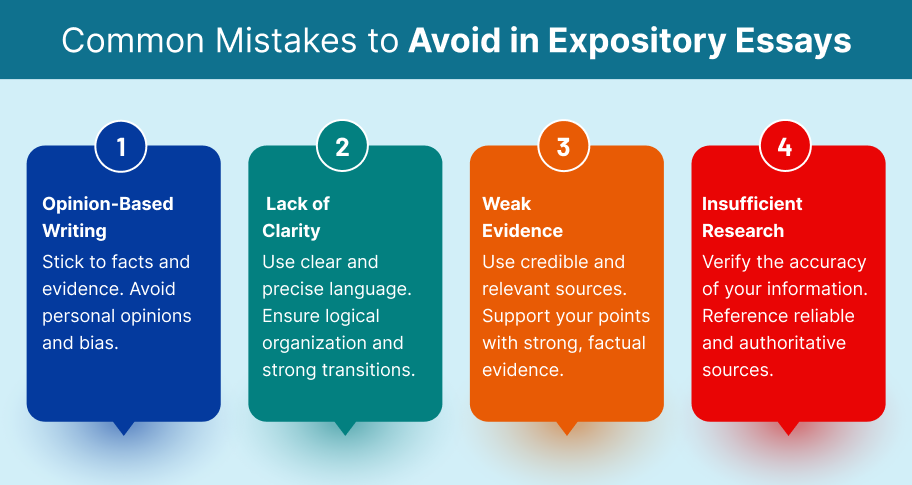
Opinion-Based Writing
Avoid subjective statements. Expository essays should be based on facts and evidence, not personal opinions. This is perhaps the most pervasive mistake student writers make. The fix is straightforward: every claim you make should be traceable back to a source, a statistic, a logical deduction from established evidence, or a widely accepted definition. If it can't be sourced or logically grounded, it doesn't belong in an expository essay.
Lack of Clarity
Use clear, concise, precise, specific, and accurate language. Logically organize the essay—and be sure that you can explain how it is logically organized. Use strong transitions between paragraphs when moving from point to point or detail to detail. A common clarity problem is the use of jargon or highly technical vocabulary without explanation. If your essay introduces a specialized term—whether from medicine, law, technology, or another field—define it on first use. Never assume your reader shares your level of familiarity with the subject.
Weak Evidence
Evidence should be relevant, convincing, strong, and factual. Support your points with credible and relevant sources to strengthen your writing. Weak evidence often looks like a single anecdote offered in place of data, or a vague reference to "studies show" without identifying any actual study. In 2026, access to peer-reviewed research has never been easier—databases like Google Scholar, PubMed, and institutional library portals make it straightforward to locate credible, up-to-date studies. There is little excuse for relying on thin or unverifiable evidence when strong sources are so readily available.
Poor Paragraph Structure
Each body paragraph should do one clearly defined job: introduce a topic sentence, develop it with evidence, and close with analysis that connects back to the thesis. A paragraph that tries to do too many things at once—or that wanders from its topic sentence—will confuse the reader and dilute the essay's overall impact. Before moving on to the next paragraph, check that the current one has fully delivered on the promise of its topic sentence. If it hasn't, either expand it or cut the elements that don't belong.
Neglecting Transitions
Transitions are the connective tissue of an expository essay. Without them, even a well-researched essay can feel choppy and disjointed. Words and phrases like "furthermore," "by contrast," "as a result," "building on this point," and "taken together" signal to the reader how each new idea relates to the one before it. Treat transitions as a structural tool, not just a stylistic nicety—they are what turn a list of paragraphs into a coherent argument.
Why Are Expository Essays So Important?
If writing expository essays frustrates or frightens you, it might help to realize why they are important. In addition to providing your instructor with evidence that you have mastered the art of scholarly writing, expository essays also show how well you have mastered the subject matter. When you are asked to explain, describe, or analyze something you learned in class, you are writing an expository essay useful for assessing your learning.
Beyond its value for teachers, expository essays also resemble different types of business communications. Therefore, the tools and skills you use for expository essay writing can be transferred easily to your current and future work. If you are new to expository essay writing, developing your skills now will help you perform better in future coursework and in your professional life. Expository essays allow you to improve essential written communications skills.
In fact, the professional relevance of expository writing has grown considerably in recent years. In 2026, workplace communication increasingly takes forms that mirror expository essay structure: executive summaries, white papers, policy briefs, grant proposals, technical documentation, and analytical reports all require the same core competencies—clarity, factual precision, logical organization, and the ability to explain complex information to a non-specialist audience. Students who build strong expository writing skills in the classroom are essentially pre-building the professional communication toolkit they will rely on throughout their careers.
Remember: Expository essays are going to be one of the most common assignments you will have throughout your education. The vast majority of essays you will be asked to prepare are technically expository essays. Compare/contrast essays, cause/effect essays, process essays, analytical essays, and some argumentative essays are all expository essays. When you write an expository essay, you are explaining something, providing as much information as possible as neatly as possible.
Expository Essays FAQ
- What is the purpose of an expository essay?
- Expository essays aim to inform, explain, or describe a topic clearly and concisely.
- How do I choose a topic for an expository essay?
- Select a relevant and manageable topic that has some interest for you or your reader. Be sure it is something you can research or that you are interested in. See below for more ideas if you're still having trouble coming up with one.
- What are the key components of an expository essay?
- The essential elements are the introduction, thesis statement, body paragraphs, and conclusion. And, of course, there should be a single topic upon which the paper is focused.
- How can I ensure my expository essay is well-organized?
- Structure the essay logically and consistently—thematically, sequentially, chronologically, or by order of least important point to most important point.
- What are common mistakes to avoid when writing an expository essay?
- Avoid including personal opinions, losing clarity, or giving insufficient evidence; make sure your facts are accurate, and stick to the point.
- How long should an expository essay be?
- Length depends on the assignment, but most academic expository essays range from 500 to 1,500 words. A five-paragraph structure works well for shorter assignments; longer, more complex topics may warrant six to eight paragraphs or more. Always follow your instructor's specific guidelines.
- Can I use first-person in an expository essay?
- Generally, no. Expository essays are written in third person to maintain an objective, fact-based tone. First-person language invites the perception of personal opinion, which undercuts the essay's credibility. Check your assignment instructions—some instructors permit first person in specific contexts, but the default for expository writing is third person.
- What citation format should I use?
Conclusion
In conclusion, expository essays are a big part of academic writing. Their purpose is to inform, explain, or describe a topic with clarity. It's a good way for teachers to see what you know about a subject and how well you can present that information. Understanding the different types, structure, and common mistakes can improve your writing.
Remember to stay objective, use credible sources, and continuously refine your writing.
Avoid plagiarism. Academic honesty is expected of all students. When you research the topic you selected, you will sometimes be paraphrasing from what you have read. Make sure you properly cite your sources when you paraphrase. Any time you borrow information or a direct quote, you need to cite the source using whatever citation format your instructor asked you to use. The most common citation formats include APA, MLA, and Chicago. If you are ever in doubt, it is better to include a citation than to omit one. You might get accused of plagiarism if you inadvertently took someone else's idea and incorporated that information into your expository essay.
It is also worth noting that in 2026, AI writing tools have made plagiarism detection more sophisticated and more nuanced simultaneously. Instructors are increasingly aware of the difference between AI-generated text, paraphrased human sources, and original student writing. The best protection against any accusation—whether of plagiarism or of academic dishonesty involving AI—is to do your own thinking, document your sources meticulously, and write in your own voice. An expository essay is ultimately a demonstration of your understanding, and no tool can substitute for that.
For more resources, check out our other writing guides and writing tools.
Get help with your essay
Browse 130,000+ paper examples, use our AI writing assistant, generate citations and outlines — all included.
Try PaperDue for $1 →